Chatgpt
| Developer | OpenAI |
|---|---|
| Original use | General-purpose conversational AI |
| First created | 2022 |
| Model architecture | Generative Pre-trained Transformer |
| Deployment rule | Cloud-based API and web interface |
| Access method | Subscription and free tiers |
| Primary function | Text generation and analysis |
Origin and history
ChatGPT originates from the United States, developed by the artificial intelligence research organization OpenAI. Its underlying model architecture, the Generative Pre-trained Transformer (GPT), was first introduced in the late 2010s. The specific model known as ChatGPT was launched to the public in the early 2020s, building upon several iterative versions of the GPT series. These earlier models established the technical foundation of using transformer-based neural networks trained on vast text corpora. The development of ChatGPT represented a significant shift towards refining these models for conversational interaction through additional training techniques. Its public release marked a pivotal moment in bringing large language model capabilities to a broad, non-specialist audience.
What it is for
ChatGPT is designed to generate human-like text responses based on textual prompts provided by a user. Its primary function is to conduct coherent and contextually relevant dialogues across an extensive range of topics and tasks. Common applications include drafting and editing text documents, summarizing complex information, and brainstorming ideas. It can also translate between languages, write and debug code snippets, and answer factual questions based on its training data. The tool is engineered to follow instructions within a conversation, allowing it to adopt specific tones, formats, or perspectives as directed. It serves as a general-purpose language interface, not specialized for any single domain but applicable to many.
Pros and cons
A significant advantage of ChatGPT is its versatility in handling diverse linguistic tasks without requiring task-specific programming. Its ability to maintain context within a conversation allows for complex, multi-turn interactions that earlier models could not sustain reliably. A major con is its propensity to generate plausible-sounding but incorrect or fabricated information, known as hallucination, which requires careful user verification. Users often regret relying on it for critical factual research, legal advice, or precise technical data without independent corroboration. Another common mistake is overestimating its reasoning capabilities, as it operates through pattern recognition rather than true understanding, leading to failures in complex logic or mathematics. Its outputs can also reflect biases present in its training data, and it lacks genuine consciousness or intent, operating solely as a statistical text predictor.
Who it suits
ChatGPT suits individuals and organizations seeking an assistant for drafting, editing, or brainstorming written content, such as marketers, writers, and students. It is appropriate for software developers and technical users who utilize it as an auxiliary tool for explaining concepts, commenting code, or generating simple programming structures. Researchers and analysts may find it useful for preliminary information gathering and summarization, provided they critically evaluate its outputs. It is well-suited for casual users exploring creative writing or seeking conversational engagement on general topics. The tool is less suitable for scenarios demanding guaranteed accuracy, expert-level specialist knowledge, or ethical and legal decision-making without human oversight. Enterprises deploying it often integrate it into larger workflows where its output is reviewed and refined by human operators.
Latest Chatgpt news
Latest reporting
OpenAI launches Dots, always-on AI agents powered by GPT-6
OpenAI has launched Dots, its new always-on AI agents powered by the GPT-6 Astra model, for ChatGPT Pro, Business Premium, and Enterprise users.
Meta's Muse AI app downloads outpace ChatGPT's early mobile
Apptopia data shows Meta's new Muse AI app achieved 1.8 million iOS downloads in the U.S. And Canada in its first 12 days, surpassing ChatGPT's 1.3...
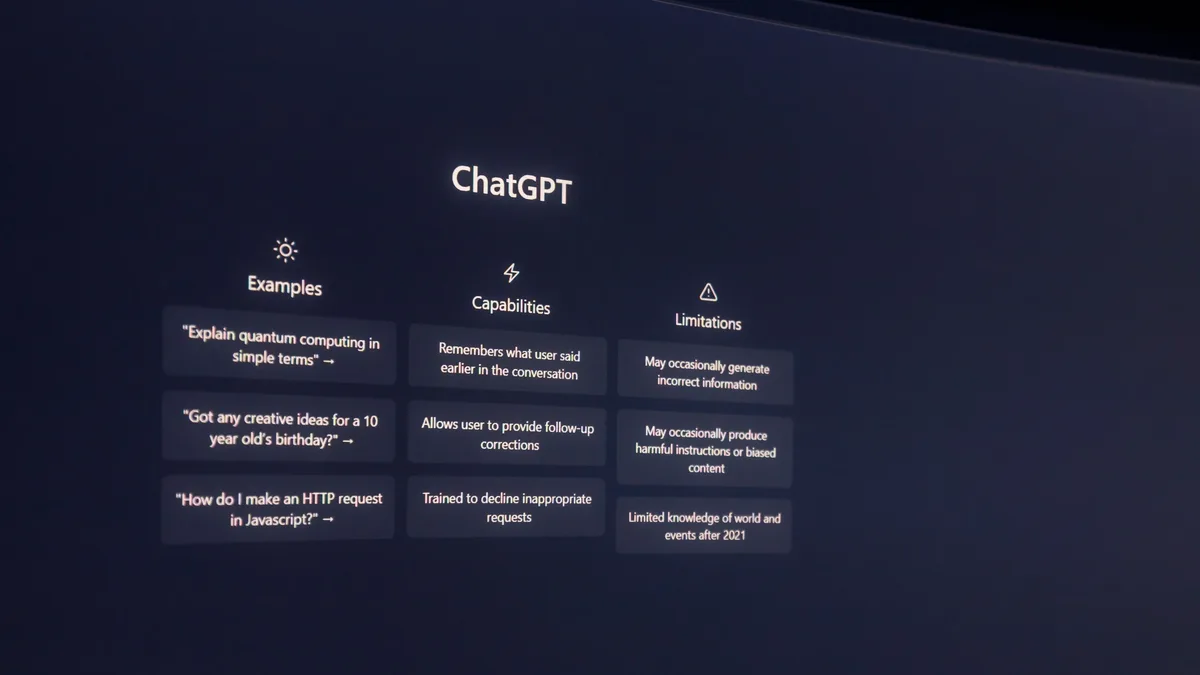
OpenAI, Anthropic, and xAI Hit by Simultaneous Outages
ChatGPT, Claude, and Grok experienced rare, concurrent service disruptions on Thursday morning, with companies offering varied explanations but no
Pentagon deploys secure ChatGPT, Grok
The Pentagon has launched custom, secure versions of OpenAI's ChatGPT and xAI's Grok for its 3 million personnel.
ChatGPT, Reddit, Roblox designated VLOSEs
The European Commission has designated ChatGPT, Reddit, and Roblox as Very Large Online Search Engines (VLOSEs) under the Digital Services Act, as...
Local LLMs Run on Your Computer
Large language models like ChatGPT can run locally on a PC for offline use and privacy, but need specific hardware and software.